
Think about your warehouse. It’s a hive of physical activity: forklifts humming, pallets moving, pickers darting down aisles, and someone in shipping wrestling with an unruly tape gun.
Now think about where your Fishbowl ERP system lives. It’s sitting on a desktop computer tucked into a quiet office corner, buried under three dusty binders and a slightly-too-old energy drink.
That setup creates a constant operational paradox. Your physical operations are fast, fluid, and mobile, while your data core is static, tethered, and stationary. Every time an employee walks back to a desk to check stock levels, verify a purchase order, or enter a pick, you pay for that disconnect in extra steps, delayed updates, and human error.
Transitioning to a mobile-first warehouse management strategy isn’t just about handing out tablets or buying smaller screens. It’s about aligning your software interface with the physical realities of your floor. By placing primary ERP capabilities directly into the hands of your staff wherever they work, you turn a stationary database from an anchor into an active driver of productivity.
The ERP as a Ball and Chain
In a conventional desktop setup, data updates almost always trail behind physical reality. Consider a busy receiving dock on a Tuesday morning. Multiple shipment trucks arrive at once. In a paper-and-desktop workflow, dock workers print out receiving reports, tally boxes by hand on clipboards, jot down notes about damaged packaging, and eventually trek back to an office terminal to manually key in the data.
By the time Fishbowl reflects that new inventory, hours may have passed. During that lag, customer service representatives might tell callers an item is out of stock when it is actually sitting on dock pallet #3.
Worse, forcing active warehouse workers to act as part-time desktop data entry clerks introduces predictable friction:
- Transcript Errors: Deciphering handwriting recorded on a clipboard after a six-hour shift leads to miskeyed SKUs and quantities.
- Wasted Footsteps: Walking back and forth between warehouse aisles and central computer stations adds miles of dead-time travel every week.
- Process Bottlenecks: Lineups form at shared computer kiosks during peak picking and shipping windows.
Going mobile-first removes these friction points by capturing data at the exact moment and location an action occurs. It shifts your workforce away from retroactively reporting what happened hours ago toward managing live inventory in real time.

The Mobile-First Mindset: Giving Power to Your Thumbs
A true mobile-first approach does not mean creating a stripped-down, read-only “lite” app. It means that the handheld screen—whether on a tablet, a phone, or a ruggedized industrial scanner—becomes the primary engine for executing everyday warehouse workflows.
Dock Receiving Without the Desk
With a mobile device at the dock, a receiving worker pulls up the incoming purchase order, scans items as they are unloaded, and inputs accurate quantities directly into the system. If a carton arrives crushed, the worker snaps a photo using the device camera and attaches it directly to the receiving record in Fishbowl before moving the goods into putaway. The inventory updates across the entire company instantly.
Error-Proof Picking and Packing
Rather than navigating aisles with paper pick tickets, pickers use handheld screens that guide them along optimized pick routes. Barcode integration turns verification into a seamless step: a quick scan of the bin location confirms the picker is at the right rack, and a scan of the product barcode verifies the correct SKU.
Mistakes are caught and corrected immediately on the floor—preventing mispicks from reaching packing tables or customer doorsteps.
LilyPad Nexus: Unleashing Fishbowl ERP from Its Desk
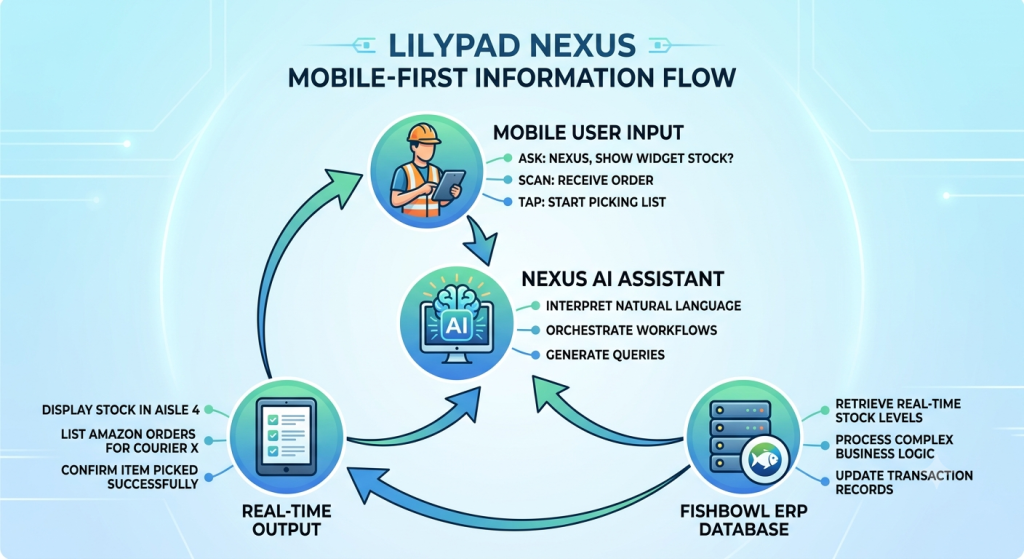
Unlocking this level of mobility within Fishbowl ERP doesn’t require replacing your core database or undergoing a costly, disruptive software migration. LilyPad Nexus acts as an AI-powered web client that extends Fishbowl’s backend into a responsive, browser-based mobile environment accessible from any device.
Instead of forcing floor staff to navigate dense desktop menus on a handheld screen, LilyPad Nexus pairs a mobile-native interface with natural language processing and intelligent automation.
1. Instant Visibility via Natural Language
Warehouse managers spend hours every day answering routine status questions. Is Component B in stock? Has Purchase Order 1042 arrived? Where is the hold up on afternoon shipping?
With LilyPad Nexus, getting those answers no longer requires walking to an office or generating custom SQL reports. A manager walking the floor opens Nexus on a smartphone and speaks or types naturally:
- “Nexus, show available quantity for SKU 8812.”
- “Which orders are currently waiting on backordered parts?”
- “List all open POs scheduled for delivery today.”
Within seconds, live data retrieved straight from Fishbowl displays on screen, enabling immediate decision-making right where the work is happening.
2. End-to-End Untethered Workflows
Nexus moves complete operational cycles out into the aisles. As pickers work through dynamic digital lists, inventory counts update across Fishbowl in real time. Sales teams see stock availability update the second dock workers finish receiving a shipment. Customer service can confirm whether a specific order has been packed without calling floor supervisors or leaving their desks.
3. AI-Guided Floor Execution
LilyPad Nexus moves beyond standard data display by using built-in AI to assist workers with complex tasks.
- Smart Putaway Advice: If a receiving worker unloads a bulk shipment of high-turnover goods, they can ask Nexus: “What is the best putaway location for this item?” The assistant checks current bin capacities and historical pick frequencies in Fishbowl to recommend an optimal location.
- Automated Batch Processing: A warehouse lead can execute multi-step administrative tasks with simple prompts like: “Generate pick lists for all express orders shipping via Courier X today” or “Compile a reorder list for SKUs below safety stock.”
Modern Tools for an Active Workforce
Warehouse workers are on their feet all day keeping goods moving. Tying their primary operational software to a stationary desktop computer slows them down, creates unnecessary data lag, and introduces avoidable errors.
The linked page summarizes options for Australian players around low minimum deposit casinos and common payment methods, including information useful to those comparing entry‑level deposit thresholds.
Adopting a mobile-first strategy with LilyPad Nexus gives your team modern, intuitive tools that match the active pace of warehouse operations. By bringing natural language queries, barcode verification, and real-time Fishbowl data to smartphones and tablets, you eliminate paper trails and redundant steps—allowing your team to focus on moving inventory quickly, accurately, and efficiently.