If you distribute patio furniture and a pallet gets mixed up, someone gets the wrong umbrella stand. Annoying, but survivable. If you distribute medical devices and a pallet gets mixed up, you might not know which hospital has the affected units until you’ve already had an uncomfortable phone call with the FDA.
That’s the short version of why medical device distribution is its own animal. Every unit needs a paper trail, expiration dates aren’t a suggestion, and “we’ll figure out which lots went where” is not an acceptable answer during a recall.
Here’s what actually makes this vertical different, and where the pressure points show up.
The short answer
Medical device distributors carry three burdens that most wholesale distributors don’t: regulatory identifiers that have to travel with every unit, lot- and expiration-level traceability that needs to work in both directions (backward to the source, forward to the customer), and inventory that sometimes doesn’t even live in their own warehouse.
A general-purpose distribution setup can ignore all three. Yours can’t.
Every unit needs a paper trail: UDI, DI, and PI
The FDA’s Unique Device Identification system requires most devices to carry a UDI on their label and packaging. That UDI has two parts: a Device Identifier (DI), which is the fixed part that identifies the labeler and the specific device model, and a Production Identifier (PI), which captures the lot number, serial number, expiration date, and manufacture date, depending on what applies to that device.
The DI gets submitted to the FDA’s Global Unique Device Identification Database, or GUDID, which is the central registry tying device records back to their regulatory history.
Here’s the part that trips people up: in most cases, submitting to GUDID is the manufacturer’s job, not the distributor’s. You don’t inherit that obligation just by reselling the device. But there’s a catch — if you relabel, repackage, or re-sterilize a device before it goes out the door, you become the “labeler” for that unit, and the GUDID responsibility comes with it.
Even distributors who never touch the packaging still have to make sure every device they resell carries a compliant UDI, and that the UDI travels through purchase orders, shipping documents, and packing slips. It’s increasingly common for hospital contracts to require UDI data on every invoice line, so this isn’t just a nice-to-have anymore — it’s what gets you paid.
When something goes wrong, how fast can you find every affected unit?
Manufacturers and importers are required to hold onto device records for two years beyond the device’s expected life. As a distributor, you’re usually not the one on the hook for that specific retention clock, but you’re very often the one who gets the call first when a hospital or a manufacturer needs to know exactly where a lot ended up.
That means the real question isn’t “do we have lot numbers.” It’s whether a lot number actually connects backward to what you received and forward to every customer who got a unit from it. A lot number sitting in a spreadsheet that nobody’s cross-referenced against shipments isn’t traceability. It’s a decoration.
A good habit here, and one that costs nothing but an hour: run a mock recall every so often. Pick a random lot, trace it forward to every customer it touched, and time how long it takes. If the answer is “a few days and three phone calls,” that’s useful information to have before you’re doing it for real.
Expiration dates aren’t a suggestion
A lot of medical devices are sterile, and sterility has a shelf life. Kits and trays often bundle multiple components with different expiration dates, which means the whole kit is only as good as its earliest-expiring piece.
First-expired-first-out isn’t a nice inventory discipline here, it’s the difference between shipping something usable and shipping something a hospital has to throw away or, worse, almost doesn’t catch. Visibility at the point of picking, not just at receiving, is what actually prevents this.
Not all of your inventory lives in your warehouse
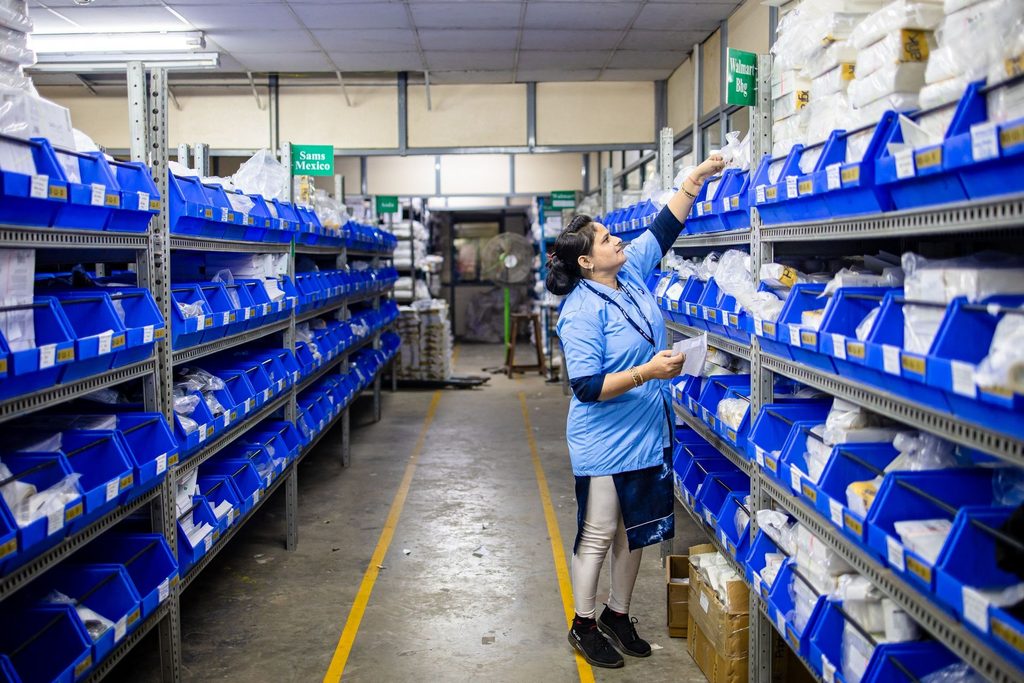
Picture a hypothetical distributor we’ll call Harbor Med Supply. Most of its catalog sits in its own warehouse, but a chunk of higher-value inventory is consigned at hospital sites, and a handful of loaner kits are constantly circulating between facilities for specific procedures.
That’s a pretty normal setup in this industry, and it adds a layer that a lot of general distribution software wasn’t built to handle: inventory you own, but don’t physically control the location of, day to day.
Getting a clean read on what’s on your own shelves is one problem. Knowing what’s sitting in a consignment closet three states away is a different problem entirely, and it deserves an honest answer rather than a guess based on the last cycle count.
Selling into hospitals means selling into layers of pricing
Hospitals buy through group purchasing organization (GPO) contracts, direct relationships, or a mix of both, often for the same product line. That means your price book isn’t one price book, it’s several, and the wrong one showing up on an order is its own kind of headache, just a financial one instead of a regulatory one.
Where the right tools come in
None of this is solvable by wishing harder at your spreadsheet. What actually helps is inventory tooling that treats lot numbers, serial numbers, and expiration dates as first-class data instead of a text field nobody enforces — and that’s connected to the ERP you’re already running, whether that’s Fishbowl, Cin7, Katana, or EPICOR, rather than living in a separate system your team has to remember to update.
When a recall question comes in, “which lots shipped to which customers in the last 90 days” should be something your system can answer in seconds, not something your ops manager has to reconstruct by hand on a Friday afternoon.
That’s increasingly the kind of question AI-assisted tools layered on top of your existing ERP are built to handle — pulling the answer straight from data you already have, instead of adding one more platform to manage.
A few quick answers
Do distributors have to submit device data to GUDID?
Usually not — that’s the manufacturer’s or labeler’s job. You inherit it only if you relabel, repackage, or re-sterilize the device yourself.
What’s the difference between UDI-DI and UDI-PI?
The DI identifies the device model and labeler and stays fixed. The PI carries the variable stuff — lot, serial, expiration, manufacture date — that changes unit by unit or batch by batch.
How long should we keep lot and shipment records?
Manufacturers and importers must retain theirs for two years beyond a device’s expected life. Matching or exceeding that on your own end is a reasonable practice, especially since you may be the first call during a recall.
Does every device need individual serial tracking, or is lot tracking enough?
It depends on the device. High-volume, identical devices are typically tracked by lot; more complex or individually distinct devices are more often serialized. Check your specific product requirements rather than assuming one approach covers everything.
If you read through this and started mentally listing which of these your current setup handles well and which ones it doesn’t, that’s a pretty good sign it’s worth a closer look before a recall forces the question.