









Can you run a consumer web store and a wholesale business at the same time? Yes! Plenty of product businesses do it.
The trouble starts when each channel gets its own process, its own spreadsheet, and its own version of what’s in the warehouse. The fix is to let both channels draw from one inventory source, and to let wholesale customers place their own orders instead of emailing them to you.
Here’s how to get there without losing your weekends.
Why do so many businesses end up selling both ways?
It usually isn’t a grand strategy. A business starts with a web store, and a local shop asks if it can buy twelve cases. Or it starts out selling wholesale, and someone says, “Why don’t you just sell this online?” Both channels are good for growth, and they want different things.
Direct-to-consumer (DTC) customers buy one or two items, expect fast shipping, and pay full price. Wholesale customers buy in volume, reorder on a schedule, and usually expect their own terms. They’re different customers with different habits, but they’re buying from the same shelves.
What goes wrong when the two channels run separately?
Picture a hypothetical company, Juniper Ridge Candle Co. (invented for this article, so don’t go looking for it). Juniper Ridge sells hand-poured candles through its web store. Over time, a handful of gift shops start buying wholesale.
Here’s how the wholesale side works in the early days. Shop owners email their orders, or text them, or leave a voicemail on a Friday afternoon. Someone on the team retypes each order into the system. Someone else checks whether there’s enough stock. Meanwhile, the web store keeps selling the same candles to consumers.
That setup creates a few familiar problems:
- Double handling. Every wholesale order gets typed at least twice, once when it arrives and once when it goes into your system. Every retype is a chance for a typo.
- Stock that’s promised twice. The web store sells the last forty candles while a wholesale order for those same forty is sitting in someone’s inbox.
- Slow answers. Customers wait for a reply to “do you have this in stock?” because answering means someone has to go check.
- Invisible reorders. A repeat buyer can’t pull up what they ordered last time, so they ask you, and you go digging through old emails.
None of this is a disaster on its own. Together, it’s a tax on your team’s time that grows with every new wholesale account.
What does “one inventory source” actually mean?
It means your web store, your wholesale orders, and your warehouse all answer to one set of numbers. When a consumer buys a candle online, the count goes down. When a wholesale buyer orders a case, the count goes down. Nobody has to reconcile two lists at the end of the week.
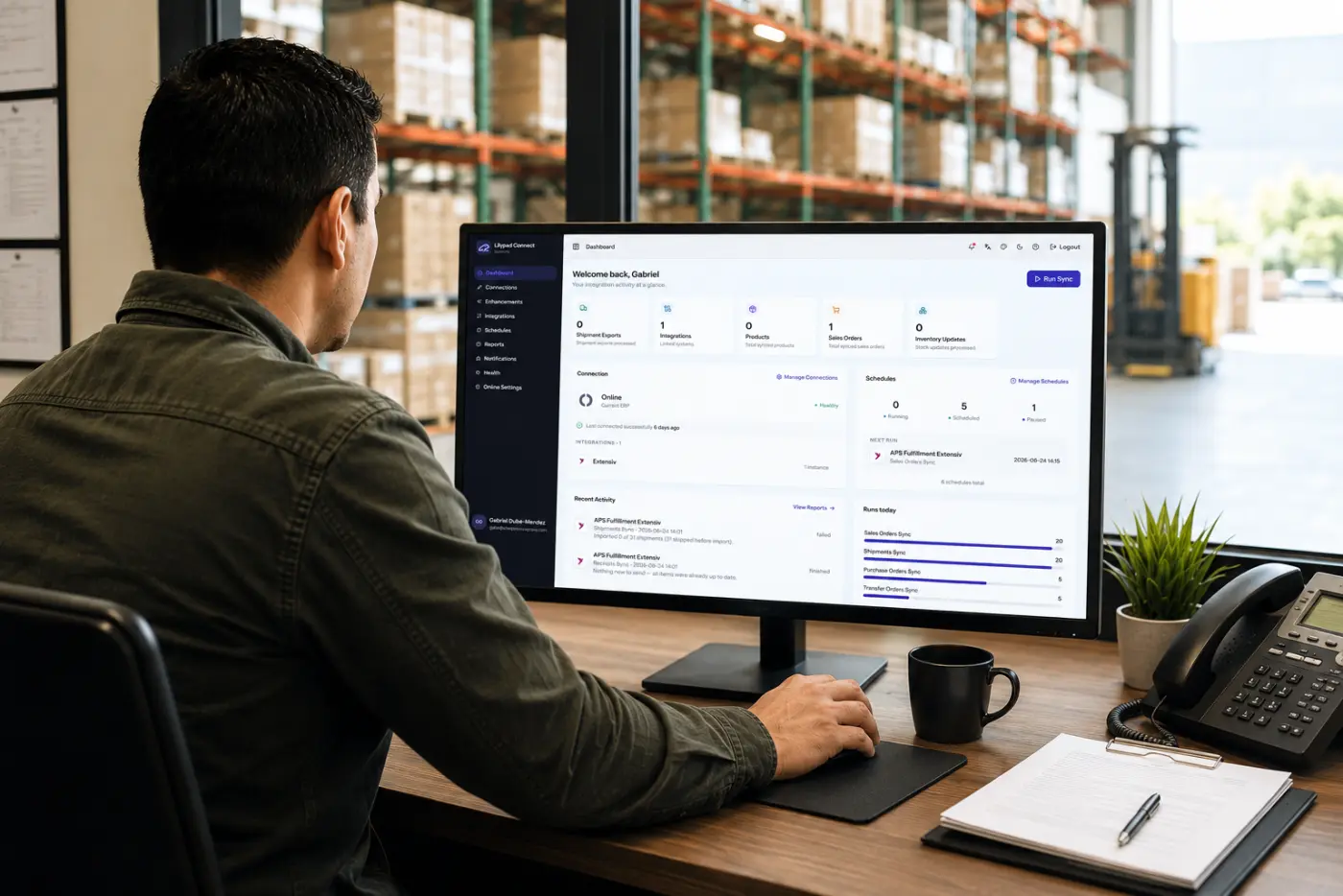
This is why businesses often put an inventory system or ERP at the center of their operation. It acts as the referee between channels. The shopping cart handles the storefront experience, and the inventory system keeps the facts straight.

Why not just give wholesale customers a login to the regular web store?
Some businesses try this, and it can work for a while. But a consumer storefront is built for browsing and impulse buys. Wholesale buyers want something more like a catalog and an order form. They know what they need and want to get in, enter quantities, and get out.
They also tend to have repeat patterns. A shop that orders the same dozen items every month wants a fast way to do that, and a storefront designed for one-off shoppers doesn’t always give them one.
A dedicated B2B portal separates the two experiences while keeping the data shared. Your consumers get the storefront, and your wholesale accounts get a portal that fits how they buy. Both feed the same inventory.
What should a wholesale ordering portal do?
When you’re evaluating options, here’s a practical checklist:
- Let customers order on their own schedule. Evenings, weekends, and the middle of a holiday week all count.
- Connect to your inventory system. If it doesn’t, you’ve just moved the retyping problem somewhere else.
- Be easy to browse. Buyers should be able to shop by category and find things quickly.
- Be easy for your team to run. If the portal needs a specialist for every change, it won’t stay current.
- Leave your consumer store alone. Adding wholesale shouldn’t mean rebuilding the web store.
Where does LilyPad fit in?
If your inventory runs on Fishbowl, this is the problem LilyPad Vortex is built for. Vortex is a B2B sales portal that connects to Fishbowl Advanced and Fishbowl Drive.
Wholesale customers can shop by category, and those categories reflect your Fishbowl Product Tree, so the portal is organized the same way your inventory already is. Your web store keeps doing its job, and your wholesale buyers get their own front door.
If you’re still deciding whether this setup is right for you, a conversation with the LilyPad team is a low-pressure place to start. They also handle Fishbowl implementation and training, which helps when a new channel is also a good excuse to clean up how your inventory is set up.

How do you add wholesale without breaking what already works?
A few habits help, whatever tools you end up using:
- Start with your best repeat accounts. They already know what they want, and they’ll tell you quickly if the portal is working.
- Clean up product data first. Consistent names, SKUs, and categories make everything downstream easier.
- Decide who owns the stock. Some businesses reserve inventory for wholesale. Others let channels compete first-come, first-served. Either can work, but pick one on purpose.
- Keep one place to look. If your team has to check two systems to answer a stock question, you haven’t really merged the channels yet.
FAQ
Can I sell wholesale and retail from the same inventory?
Yes. The key is having one system that tracks stock for both channels, so a sale in either one updates the same counts.
Do I need a separate website for wholesale customers?
Not necessarily a whole separate site, but a separate ordering experience usually helps. Wholesale buyers order differently from consumers, and a dedicated portal fits them better than a standard storefront.
What’s the biggest risk of selling both ways?
Overselling. If each channel works from its own numbers, you can promise the same stock to two customers. Shared inventory data is the main protection.
Will a wholesale portal replace my sales team?
Not likely. It takes over the routine reorders and order entry, which frees your team up for relationship-building and bigger deals.
Does LilyPad Vortex work with my ERP?
Vortex connects to Fishbowl Advanced and Fishbowl Drive. If you use a different system, check with the LilyPad team about your setup.
The bottom line
Selling to both consumers and wholesale buyers is a good problem to have, but it works best when both channels share one source of truth and wholesale customers can order without a phone tag marathon.
Get the foundation right, and a second channel adds revenue without adding chaos.