Walking through a warehouse filled to the rafters feels like a security blanket. For many operations managers, those towering pallets represent a promise: “We will never tell a customer ‘No.’” But if you look closely at your balance sheet, that security blanket might actually be a weighted vest. In the 2026 market—where warehouse real estate is at a premium and interest rates have stabilized at a higher floor—excess inventory isn’t just “extra.” It’s a cash vampire. Welcome to the Safety Stock Trap. It’s the point where “just in case” inventory stops being an insurance policy and starts being a liability.
The Hidden Costs of a “Full” Warehouse
Too many SMBs assume that the cost of inventory is simply what they paid the vendor, but in reality, that’s just the tip of the iceberg.
1. Capital Lockdown
Every dollar sitting on a shelf is a dollar that isn’t being spent on marketing, R&D, or expanding your sales team. When your cash is “trapped” in cardboard, your business loses its agility.
2. The 25% Carrying Cost Rule
Industry experts generally agree that the inventory carrying cost is roughly 20% to 30% of the inventory’s value per year. This includes:
- Insurance & Taxes: The more you have, the more it costs to protect.
- Warehouse Utilities: Lighting, heating, and cooling space for items that aren’t moving.
- Labor: The “Manual Tax” of moving, counting, and organizing stock that just sits there.
3. The Risk of Obsolescence
In 2026, product cycles move faster than ever. Whether it’s a shift in consumer tech, a change in food safety regulations, or a simple trend shift, “Safety Stock” often becomes Dead Stock before it ever finds a buyer.

Why We Over-Order (Psychology vs. Data)
Inventory problems rarely start with bad intentions; they start with fear.
We’ve all lived through the “Stockout Trauma” that one time a best-seller ran out during a peak season, a major client walked away, and the boss was livid. To prevent that pain from ever happening again, we add a “little extra” to every order.
Then there’s the Volume Discount Trap. A supplier offers a 5% discount if you order 1,000 units instead of 500. On paper, you saved money. In reality, if those extra 500 units take six months to sell, your carrying costs have already eaten the 5% savings and then some.
Moving Beyond the Guess: The Math of the Reorder Point
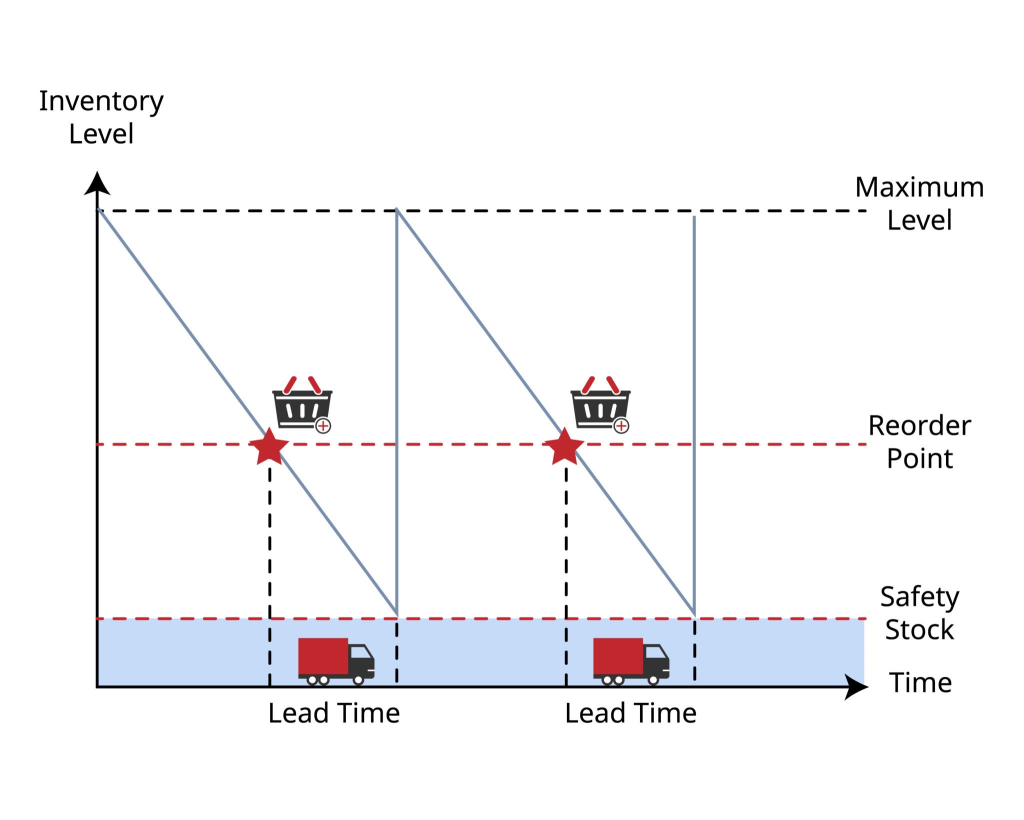
To escape the trap, you have to move from “gut feelings” to data-driven replenishment. The goal is to find your Reorder Point (ROP)—the exact moment you need to pull the trigger on a new PO.
The basic formula for a healthy Reorder Point is:
(Average Daily Usage X Lead Time in Days) + Safety Stock = Reorder Point
Calculating Actual Safety Stock
Safety stock shouldn’t be a random 10% adder. It should be calculated based on Lead Time Demand Variability.
If your supplier is always exactly 10 days late, you don’t need safety stock; you just need to update your lead time. You only need safety stock to cover the uncertainty of when the truck will show up or when a sudden spike in demand occurs.

Using Software to Reclaim Your Cash
If you are still managing your reorder points on a spreadsheet, you’re playing a losing game. Modern platforms like Fishbowl, Cin7, and Katana are designed to do the heavy lifting for you.
- Automated Alerts: Instead of walking the aisles with a clipboard, your system should flag a “Low Stock” alert the second a Sales Order drops you below your calculated threshold.
- Historical Forecasting: Use your software to look at the last 12 months of sales. It can help you identify seasonal peaks so you can temporarily increase safety stock in November and “lean out” in January.
- Cycle Counting: Your data is only as good as your last count. Regular cycle counting ensures that when the system says you have 10 units left (triggering a reorder), you actually have 10 units.
3 Steps to “Thin Out” Your Inventory Today
You don’t need a total overhaul to see immediate results. Start here:
- Run an Inventory Aging Report: Identify anything that hasn’t moved in over 90 days. Consider a “flash sale” or a bulk liquidation to turn that cardboard back into cash.
- Audit Your Lead Times: Check your last five Purchase Orders. Did the vendor actually deliver in 14 days, or was it closer to 21? Update your software settings to reflect reality.
- Negotiate Frequency, Not Volume: Ask your suppliers if you can commit to a yearly volume but receive it in monthly shipments. You’ll keep the discount without the storage headache.
Conclusion: Inventory is a Liability Until It’s Sold
In the world of SMB warehousing, liquidity is king. A warehouse full of “Safety Stock” might feel like a fortress, but if you can’t pay your bills because your cash is sitting on Rack 4-B, that fortress is a prison.
By calculating your reorder points and trusting your data, you can stop over-ordering and start reinvesting that found capital back into your business growth.
Is your cash trapped on your shelves? Contact LilyPad Applications today for a workflow audit. We’ll help you optimize your inventory levels in Fishbowl, Cin7, or Katana so you can stop guessing and start growing!